This in excerpt from an SGIA article for more on the article you can download the file here: digitalink_0706. It also contains a great glossary of terms too!!
Ink Type
Characteristics
UV Ink
More versatile in terms of what they can be printed on, rigid substrates, such as board product, plastic, glass, wood, ceramics and metal.
Can help achieve fast production because there is no wait time for prints to dry.
Save on production costs and media versatility despite having up front equipment costs that are higher than other digital printers.
Avoid continual cleaning and purging of the print head to remove insoluble products.
Solvent Ink
Commonly regarded as the most economical inks for digital printing today, in terms of equipment costs and maintenance expenses.
Produce highly durable outdoor prints.
Media is less costly than coated media for aqueous inks.
Well suited to printing on soft and compatible flexible materials.
They can be used on low-cost, uncoated materials, such as self-adhesive vinyl, fabrics and scrim banner materials.
Mild Solvent Ink
Often dubbed “mild,” “low-odor” and “eco-solvents” because they are more economical than conventional solvent inks.
Tend to have a low odor during production.
Aqueous or Water-based Inks
Primarily derived from water, 70 to 90 percent, with a small amount of a milder solvent so that the ink will adhere to the medium.
Mostly used for retail POP for short-term outdoor prints, long- lasting indoor prints and indoor backlit materials.
Have a relatively clean handling process.
“Bio” or vegetable-based inks
Made with vegetable oil rather than petroleum oil. The vegetable source, coming from soy, linseed or corn, to make ethanol uses fewer non-renewable sources such as petroleum. However, some conventional solvent is typically used as well.
Adhere to a wide range of uncoated media.
Deliver nearly the same durability as compared with conventional solvent inks.
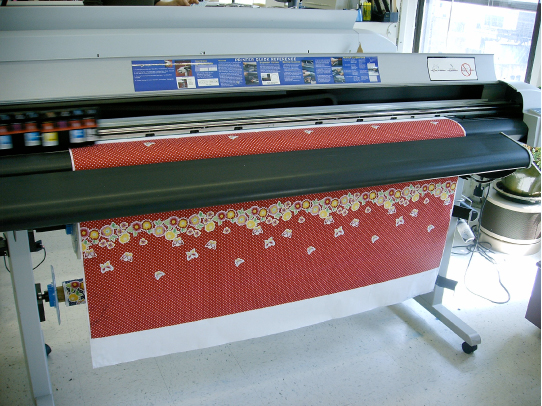
I recently had the chance to read this article posted by the Fabric Graphics Magazine on the reasons for the growth of digital fabric printing.Even from the start of my thesis, I have noticed a large growth in the options for the printer in the range of substrates for digital fabric printing but I still believe there is challenges when it comes to the production speed of the digital printers versus that of the traditional printing methods for fabric. However, digital fabric printing would be AWESOME for designers who are starting out in the industry and need a short run of fabric. You can find the full article here from FGM:http://fabricgraphicsmag.com/articles/0911_ee_digital_growth.html.
 Arianna Valentini